The View From the Lyft Going Past 16th Street BART
Between 2020 and 2025, some 4,527 new units of housing were built in San Francisco, a city with a population of around 826,079 people; in 2021, a report estimated that San Francisco had 61,473 vacant homes, though others have since noted that the many categories that fall under the phrase vacant homes — for rent, rented but not occupied, for sale, sold but not occupied, vacation homes, or otherwise vacant — are an occasion for nuance; according to the latest city data I could find — January 17th, 2026 — the hotel occupancy rate in San Francisco was 55.1%, although in more tourist-y seasons, it reaches highs closer to 78.3%; in 2024, we had around 35,527 hotel rooms. These days, people in San Francisco seem to prefer to think in numbers, rather than whatever it takes to watch a homeless person scream in unfathomable agony on a busy commercial street.
For someone like me, growing up in Austin, Texas, San Francisco still had the appealing residue of 60s counterculture and the city’s otherwise famous perverts, both queer and not, who loved and lived art. Recently, however, SF’s national reputation is that of being the avatar for the tech industry, one that has produced an exorbitant amount of wealth by filling our lives with a number of modern conveniences, many of which are surely helpful, but the most visible of which, we all acknowledge, on some level, are spiritually torturing us. Locally, tech workers are the face of gentrification: near the 16th Street Bay Area Rapid Transit station, in The Mission, the historically Latino neighborhood, you can find any number of stickers, wheatpasted posters, and scrawled messages that tell tech workers to fuck off, sometimes in more figurative language. You can also find a lot of homeless people, usually by themselves or in groups of two or three; sometimes, they are doing drugs, and the small plaza above the 16th Street station is where the homeless typically congregate in numbers large enough to warrant articles like this one from a generally excellent local newspaper called Mission Local, entitled “16th and Mission: A Bermuda triangle of vice that eludes zoning.” As noted there, “[m]aking the four blocks that meet at the intersection walkable and habitable has been one of Mayor Daniel Lurie’s quests since taking office over a year ago.” I can tell you from living close by that while it is walkable and habitable, it is also spiritually torturous.
People sometimes say the housing problem in San Francisco has already been solved: in 2024, there were an estimated 8,323 homeless people in San Francisco, both sheltered and not, and I will leave it as an exercise to the mathematically minded reader to figure out how that works out with the numbers above — the problem, of course, isn’t that we lack the material resources to house these people — in this case, houses — something that would be literally impossible to deny, but the social-economic relations that determine how we distribute them: it is also true that our planet provides enough natural resources for us to feed every single human being alive, provided we organize ourselves in such a way where that is an absolute priority, and it’s likewise true that we don’t. There are shades to what we consider possible. It is very hard to make changes like these inside of a system designed to prevent them: imagine what would happen if a single hotel, or hotel conglomerate, decided to open its vacant rooms to the homeless, perhaps even using some sort of “algorithm” designed by the same people who — purely from the perspective of coming up with a sequence of steps that effectively solves a problem, really the only thing an algorithm is — have created many other undeniably impressive algorithms. Imagine the TripAdvisor reviews! Someone who is not from here, and for whom daily encounters with abject, homeless misery are not part of the fabric of daily life, might be upset that their vacation in San Francisco was inflected by something besides forgetting that it’s kind of cold here in the summer; the cabal of right-wing computer addicts who seem to take every opportunity to attack San Francisco — something that always makes me wistful for a city in which those shadowy trannies, dykes, and faggots were still that important — might mobilize to make things harder for this single woke hotel, or hotel conglomerate, and it may struggle to survive in its competition with the other, perhaps less woke hotels or hotel conglomerates. Thus, something Friedrich Engels said back in 1880, diagnosing aspects of an earlier stage capitalism, remains true:
It is the Darwinian struggle of the individual for existence transferred from Nature to society with intensified violence. The conditions of existence natural to the animal appear as the final term of human development. The contradiction between socialized production and capitalistic appropriation now presents itself as an antagonism between the organization of production in the individual workshop and the anarchy of production in society generally.
A few months ago, I had to take a Lyft home from a house party on the city’s more residential west side because I chose to wear shoes that looked cool but would’ve been disastrous to walk the roughly 3.7 miles home in, which is what I normally do, in either fairly uncool running/walking shoes or, as I have some sensory issues with socks, funkily colored Teva hiking sandals that have given me a truly absurd foot tan; I typically walk everywhere, or take the bus, if for whatever reason, I can’t walk, just because I really like walking. I also hate cars. This is one major reason why I choose to live in San Francisco. Often enough, telling people about my locomotion preferences, I hear concerns about pedestrian and public transit safety, particularly for women, particularly at night — I have the rare epistemic privilege of being someone who has been sexually assaulted in public, on a BART train, and so I can tell you it was rush hour, and perhaps some 20 fellow passengers chose the spiritual torture of their phones over helping me. By mid-March of this year, five pedestrians had already been killed by cars; in mid-April Dannielle Spillman, a 74 year old trans woman, was killed in a hit-and-run after getting in a minor dispute with a driver stopped at a crosswalk, who floored it, killed her, and is now being charged with murder and a felony hit-and-run. None of this is to say you shouldn’t exercise caution when moving through the city, simply that it is the nature of interpersonal violence that it can happen anywhere, anytime.
I am now on a first name basis with a few homeless people, both sheltered and not, because, a few years after being assaulted in public, I have learned to be generally open and kind with strangers; in addition to shooting the shit with people, in both the periods in which I smoke cigarettes and the periods in which I don’t, I carry them on me, often offering them in place of change I don’t always have to homeless people who ask me for things, as being open and kind makes me feel better about myself, as that is what living your values tends to do, and I know they often appreciate it, being both largely ignored by people like me and also extremely bored, which is sometimes a reason I do drugs, too. I am also addicted to anecdotes, and having street interactions is one of the all time best ways to accrue hundreds of them — the other day, a homeless man asked me for a cigarette, and when I pulled out my unmarked silver case, he said to me
American Spirits? I don’t know, I’m just guessing.
American Spirits are the canonically hipster brand of cigarette, and I have nose piercings, as well as other fashion accessories, like tattoos and transsexuality, so I thought that was a pretty funny line. He was right, of course, and if I see him again, and he can guess the color of the pack I took them from, I’ll give him two.
Volunteering at a bookstore, I have formed what I consider a very meaningful friendship with the San Francisco poet Michael Bernard Loggins, who, on account of his appearance, developmental disability, and preference to spend the entire day going around the city — often with his shopping cart full of random shit he finds, a shopping cart known, in his particular idiolect, as “the buggy” — is often treated as homeless. There is a nice Mission Local article about him that introduces him as a “poet, philosopher, and comedian,” and I can attest he provides all three of these things in spades.
Michael writes his poems on pieces of scrap paper or the paper people like me sometimes provide him — the first time I met him, this was the one he gave me, which I still use as a bookmark:
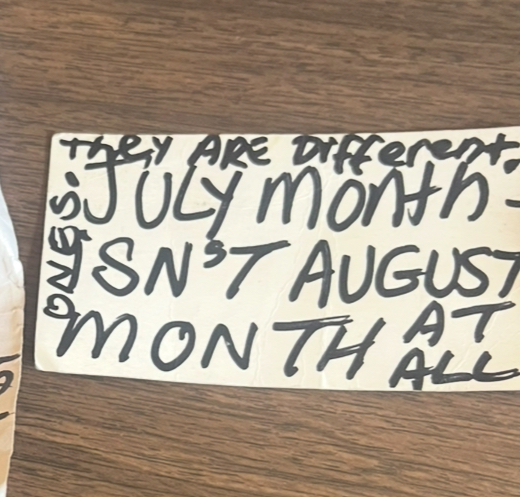
I have a few of his poems on my walls, and many others scattered about my room; when I told him this, he smiled at me in that way he does when he’s happy about the joke he’s about to make, and then he told me “you know what word I’d use for your walls . . . suffocatin.” This interaction, like a staggering number of ours, ended with me making a callback to something he says often: “people tell me I have a way with words.”
He does. At this point, I would conservatively estimate that in the nine months I’ve known him, seeing him at most once or twice a week, I have read probably a thousand of Michael’s poems; he is easily the most prolific writer I know. We have also talked quite a bit, in groups and one on one. He often comes in during my shifts at this bookstore, which I typically look forward to as time to read and sketch and have brief but usually pleasant customer interactions, or otherwise time to accrue interesting anecdotes; when he comes in, I know the next however many hours will be the hours of “MBL, himself,” his preferred way to refer to the speaker of his poems. Conversations with Michael are often interesting, as when he shares the many stories from his life, often harrowing interactions he has in public, if you didn’t know any better, you would think they had all just happened; this is particularly interesting given the very high percentage of his poems that include literal timestamps: often, they begin with the day’s date, before moving into his somewhat opaque, if almost always literarily satisfying thoughts. Once, having run into Michael outside of a bar, he handed me a stack of poems he said he had wanted to give me. I was busy when I got home and left them on my desk, only returning a week or so later. Many of the poems referred to negative interactions he had had with people we both knew.
I know very well the experience of having feelings you can only share in writing. Michael often asks me to buy him snacks — his usual order is a Diet Coke and Twinkies — and a few months ago, I proposed that we pay him a small amount to write some of his poems on the store’s bookmarks, so we could give them out to customers, something that would be good for Michael, good for the store, and — I hope — good for the customer. The first day he did this, he sat in the bookstore for several hours and wrote us 50 of them; as I read through them, I discovered that some of the feelings he could not share with me in speech were those of joy: he was grateful that I had asked him to do this, and he, as prolific a writer as I’ve ever met, was grateful to be writing once again.
I have dedicated my life to writing, and I do not know how to tell Michael how much he has taught me about it; I doubt he will ever read this essay, as he does not have a phone, and I have never once seen him read. He tends to write in pen or Sharpie, so I am also not sure I have ever seen him edit, and though he has an idiosyncratic sense of syntax and word conjugation, I have never noticed a spelling mistake — although admittedly, having almost only ever written with spell check, and, if I’m being somewhat unreasonably charitable to myself, having grown up bilingual, I myself spell at maybe a 6th grade level.
The most memorable conversation I’ve had with Michael involved him taking me up Valencia street and into various stores in which he was equally beloved. It took us about an hour to get from the bookstore I was at to the bar I was taking him to. I don’t think he drinks, but he told me he feels safe there. In this conversation, Michael told me he was lonely, and that he didn’t want to be. I have thought a lot about loneliness, as of late: after nearly 11 years, this is the first time since the late Obama era, when I was 19, that I have lived a life that wasn’t mentally organized around someone else. It is also the first time in my life I have ever lived alone: many of my nights now end with me saying goodbye to my friends, often couples, who head home with or to their lovers or roommates as I walk up to 4-ish miles through deserted San Francisco streets, usually smoking and thinking about different things, like my life and being alone and the stuff I want to write, before I get back to The Mission, where there are usually throngs of people “going out,” living, laughing, sometimes even loving, or otherwise standing on the street, usually, on my walks home, Valencia, which is one street to the west of, and parallel to, Mission Street, where the 16th Street station is; walking up and down these two streets is the easiest way to experience gentrification in San Francisco as a tourist. That night, as my Lyft passed 16th Street BART, I was thinking about how for the some 100 homeless people gathered there, this was probably a good opportunity to hang out and socialize with people that treat them like they are people; my driver’s first remark of “what’s going on over there” indicated to me he likely lived outside the city in a suburb, and his second remark, “it’s like that club where the celebrities hang out,” was what I was thinking, in different words: to be homeless in San Francisco is to experience an agonizing loneliness I cannot ever imagine; as someone who inhabits the uninhabitable 16th Street BART area, who has had to, multiple times, rouse people from their opioidal sleeps so that I can open the front door and leave my house, if I did not know that the homeless who gather there were being moved into homes and better lives, I could never support breaking up their gatherings — how could I, when one street over, people like me are doing just the same?
Having dedicated my life to articulating my understanding of the world, a project that would be meaningless to me if I could not share this understanding with others, I’ve learned that my psychology is often very opaque to others, even, perhaps especially, those who I share my real life with; I do my best to never assume I understand others’ psychologies and the way they choose to live their lives given the circumstances they have been thrown into better than they do. Like Michael, I prefer to write without another editor; this is in part because I believe the kind of writing I want to do works best when it expresses what’s individual about the individual writing it, which is why I believe that every individual is capable of writing the kind of writing I want to do, and also why I often have bad experiences with editors, who have been thrown into a situation where they have to edit with others’ — magazines’, publishers’, and readers’ — interests in mind and who also, sometimes, choose to edit with their own interests in mind. I have also had some very good experiences with editors, who have seen the things I want to do, the ways in which I am not doing them, and the ways in which they can help me do them — this is very good work, though very hard. Michael and I think very differently about the world, although often agree, if not in the expression of the idea, then certainly in the idea itself. Here is one such example:
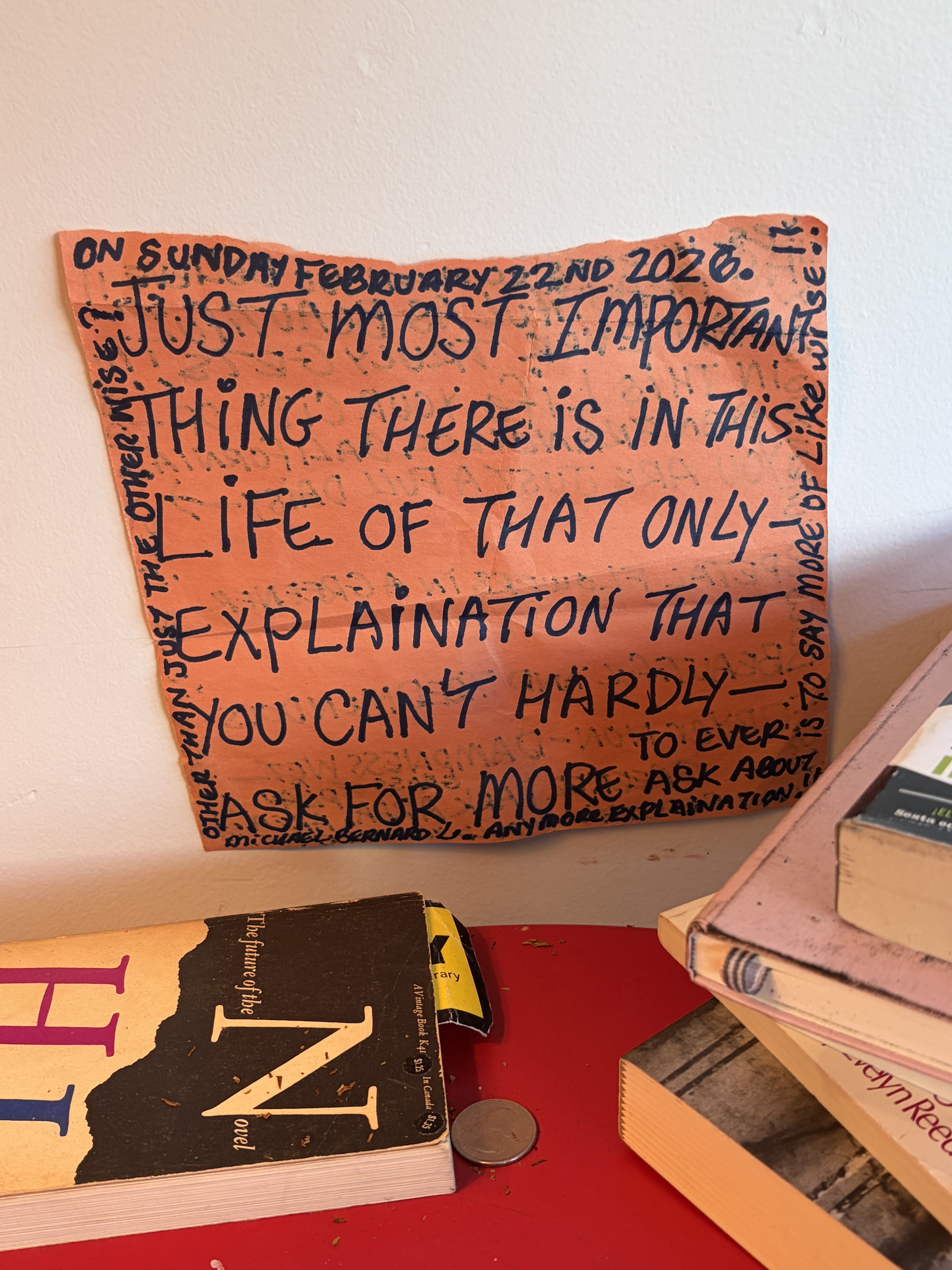
The second most memorable conversation I’ve had with Michael occurred outside the 24th Street BART station, where we talked about how someone should name a sandwich after him, “the MBL,” with the option to add something extra for a dollar or two, like avocado, thus making it “the MBL, himself.” I’d like to see it happen, though sandwichery has never been my art.